SEO
November 2026 core update: what we know and how to check if your site lost.
Google started a core update on 10 November 2026. What it announced, how long the rollout may take, why nobody knows yet who lost, and how to compare Search Console data without Black Friday skewing it.
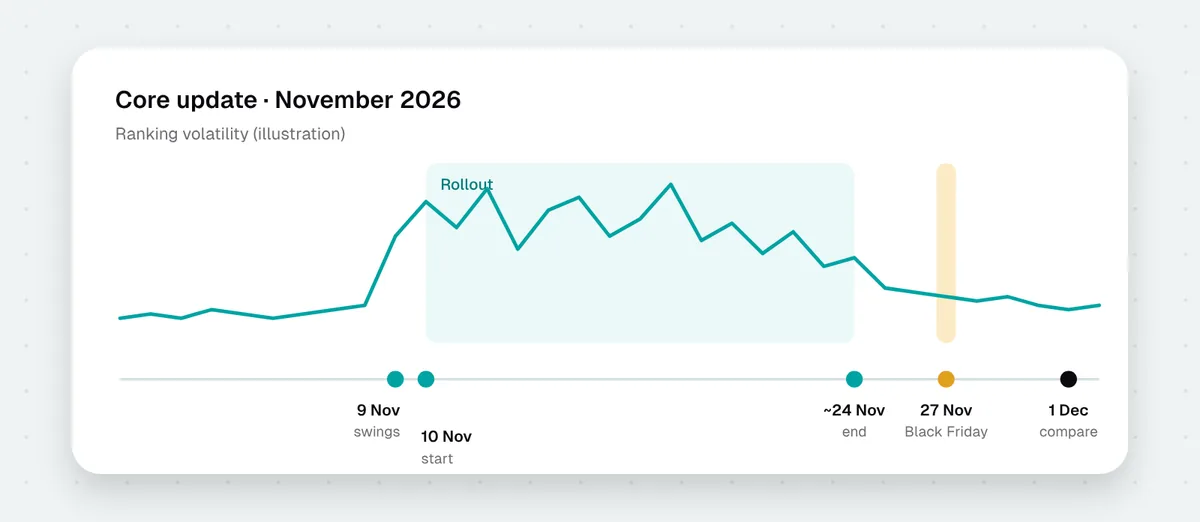
Google is changing its main ranking algorithm for the third time this year. The November core update started on Tuesday, 10 November, and is rolling out now. Below is what can be said for certain today, what nobody knows yet, and how to check the effect without confusing the update with Black Friday. I will update this article once the rollout ends and data is available.
What Google announced
The entry in the Google Search Status Dashboard appeared on 10 November at 10:06 Pacific time. It says that:
- the update applies globally and to all languages,
- the rollout may take up to 2 weeks,
- it is a “regular” core update designed to better surface relevant, satisfying content from all types of sites.
That is all. Google did not say which kinds of sites or content are the focus and did not publish a separate blog post. This is normal for core updates: Google stresses that they do not target specific sites but change the overall judgement of which answer is best.
It is the third core update of 2026, after March (27 March - 8 April) and May (21 May - 2 June). Both took about 12 days. The full history with dates is in my Google updates tracker.
Timeline: why this update is especially awkward
| Date | What happens |
|---|---|
| 9 November | Large swings in rank trackers, before any announcement |
| 10 November | Google announces the core update |
| around 24 November | Latest end of the rollout if it takes the full 2 weeks |
| 27 November | Black Friday |
| 30 November | Cyber Monday |
| from around 1 December | First full week of data after the rollout, which Google recommends for comparisons |
The problem is obvious. Google recommends assessing an update at least a week after it finishes and comparing that week with the week before it started. This year that “week after” falls in the middle of the shopping peak. A store comparing early December with early November will see growth or decline driven by the season, not the algorithm.
Who lost? Nobody knows yet
The honest answer: two days in, nobody has measured it reliably. Rank trackers show clear volatility, but:
- the rollout has only just started, so today’s drops and gains may still reverse,
- no major source has published an analysis by industry or site type yet,
- some of the volatility is noise. PPC Land reports, for example, that DemandSphere saw spurious results in about 11% of its daily checks, and Nozzle flagged 8% of results pages as affected.
If you come across “winners and losers” lists from the first days of the rollout, treat them with caution.
For a sense of scale: after the March update, SE Ranking checked 100,000 keywords across 20 niches in New York results. 79.5% of top-three URLs changed position, and 24.1% of top-ten pages fell out of the top 100. The March data covers two updates at once, spam and core, and US results only, so it is a reference point, not a forecast.
How to check whether your site lost
Now, during the rollout
- Do not change anything because of daily swings. Changes made mid-rollout make it harder to tell later what came from the update and what came from you.
- Write down what you changed on the site and when in recent weeks: releases, new content, redirects, campaigns, promotions. An annotation in GA4 is the simplest way.
- Record the week before 10 November: clicks, impressions and average position for your most important pages and queries. That is your baseline.
After the rollout
- Check the end date in the Google Search Status Dashboard or in the updates tracker.
- Wait a week and compare it with the week before 10 November in the Search Console Performance report.
- Look at positions and impressions before clicks. Position depends less on the season than clicks do. If average position holds but clicks fall, it is more likely the season or a change in how results look than the update.
- Check the Pages and Queries tabs. What matters is not only how much traffic was lost but which pages and queries lost it.
- Judge the size of the drop. Google’s own example: a drop from position 2 to 4 does not call for drastic action. A drop from 4 to 29 is a reason for a deeper look.
- Separate search types. Check web, image, video and news results separately.
If you run an online store
For stores, a week-on-week comparison in December will be skewed. It is better to:
- compare the same weeks year on year if you have last year’s data,
- look at queries and categories that do not depend on the gift season,
- track the average position of selected pages, not just clicks,
- make the final assessment in mid-December, once the promotion peak is over.
What to do if your site lost
Google does not publish a list of things to fix, because core updates do not penalise specific mistakes. Its documentation recommends instead:
- avoiding quick fixes such as removing page elements because “some SEO rule says so”,
- looking at the pages that dropped most as a user would and checking whether the pages that overtook them simply answer better,
- improving content in meaningful ways: rewriting, restructuring, adding first-hand experience and specifics,
- deleting content only as a last resort, when whole sections were made for search engines rather than people.
Improvements can pay off quickly, but it often takes months. Google says plainly that a clear change sometimes has to wait for the next core update. Before you start rebuilding, rule out other causes: a technical error, URL changes, a new site release or the season. All of them can look exactly like an update. That is what an SEO audit after a drop is for.
I will update this article after the rollout with the end date and the first reliable analyses of who lost and who gained.
Sources
- November 2026 core update - Google Search Status Dashboard
- Google Search's core updates and your website - Google Search Central
- Google's November 2026 Core Update Starts Rolling Out - Search Engine Journal
- Google November 2026 Core Update Is Rolling Out - Search Engine Roundtable
- Google's core update may run until three days before Black Friday - PPC Land
- March 2026 Google Core Update was far more volatile than December's - SE Ranking
Was this article helpful?
Great, glad it helped!
Sorry to hear that. Tell me what was missing and I will improve it: info@outrank.pl
About the author. Maciek - SEO & GEO consultant with 10+ years of experience, formerly Head of SEO at companies including Gemini Polska and Staples Solutions. More about me