News
Google now hides destinations behind google.com/goto links. What it changes in SEO reports.
Google results now route clicks through google.com/goto, and since late October Google also limits how fast these links can be resolved. What it means for rank reports and your site.
If your rank report recently showed a sudden drop in visibility, or “google.com” appeared where your domain should be, the cause is not necessarily an algorithm update. Google has changed how search results lead to websites, and in late October it added a limit that hit SEO tools hard. Below is what exactly changed, what is confirmed and what is not, and how to read reports from this period.
What changed
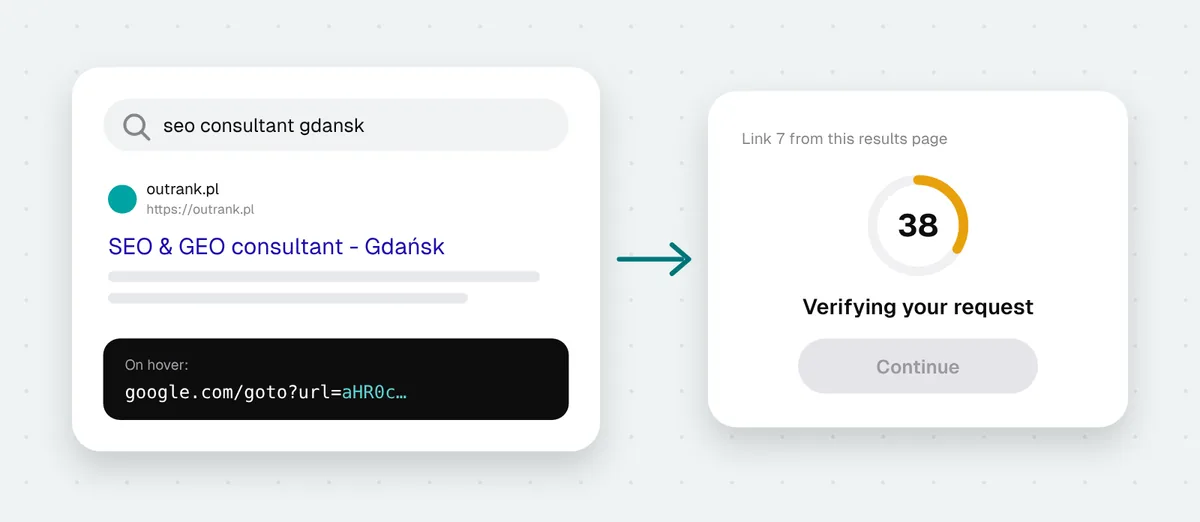
Until recently a link in Google’s results pointed straight to the website, for example outrank.pl. Now it points to an address like google.com/goto?url=..., and only then does Google redirect to the actual page. The encoded part cannot simply be read. To learn the destination you have to click the link or send Google a separate request.
For someone searching and clicking, nothing changes: they land where they wanted, and the redirect takes a fraction of a second. For programs that collect Google results automatically, such as rank trackers, competitor analysis tools and SERP data providers, everything changes.
Timeline
| When | What happened |
|---|---|
| July 2026 | First sightings of google.com/goto links in results, at that point as a test. |
| 26 August 2026 | A Google spokesperson confirms the rollout in reply to a question from Search Engine Roundtable. There is no official announcement. Nozzle sees goto links in practically all results. |
| late August - September | Data providers and SEO tools, including SerpApi, DataForSEO and SISTRIX, learn to resolve the links. Every link is an extra request, so collecting data gets more expensive. |
| from around 22 October | Unresolved goto links reappear in SERP data. According to DataForSEO, Google limited how many such links from one results page can be resolved quickly. |
| 30-31 October | EverGrow study: in data from one provider, 58.7% of organic results show google.com instead of the domain. |
What Google says
Very little, and not on its own channels. Google has published nothing about it on the Search Central blog, in its documentation or on the Search Status Dashboard. The only confirmation is a spokesperson’s reply to Barry Schwartz of Search Engine Roundtable, a single sentence: the company has “a long history of deploying technical measures against evolving forms of abuse”. Google did not say what abuse it means and did not mention SEO tools or AI companies.
The industry reads it plainly: the goal is to make bulk collection of Google results harder. SEO tools do that at scale, but so do companies building AI models and AI search engines. That is an interpretation, though, not an official reason.
The new limit: the “Continue” screen
The goto link itself is mostly a cost for tools: each one has to be opened separately to learn the real address. Derek Perkins of Nozzle estimated that fully resolving five results pages for one keyword takes 500-1,000 requests instead of a handful.
In late October Google went further. According to DataForSEO, whose reply to customers is described in the EverGrow study:
- every goto link is tied to the results page it comes from;
- when many links from the same results page are resolved in a short time, Google stops redirecting;
- instead it shows an interstitial page with a “Continue” button that only becomes active after a while;
- the first 5-6 links work instantly, later ones wait up to 40 seconds, sometimes up to 120 seconds each;
- changing the IP address or query, or waiting, does not help.
The study’s author checked it himself: on 30 October all 12 tested links returned a verification page instead of a redirect. The normal redirect only appeared after 3 minutes.
For a tool that checks thousands of keywords a day, that is a huge slowdown. So instead of waiting, some data providers simply return the unresolved link, which means google.com instead of your domain.
What it means for your reports
This is the most important part for site owners. If you use a rank tracker or get reports from an agency, data from late October may show:
- apparent ranking drops: the tool did not recognise your site because it saw google.com/goto instead of your address;
- “google.com” among your competitors or in share of visibility;
- gaps and delays in data, because providers slowed down collection or skip some results;
- broken historical series: the chart jumps on the day data collection changed, not visibility.
In the EverGrow study there was not a single such result out of more than 71 thousand up to 21 October. In the week of 22-28 October there were 99, and on 30 October more than half. That shows well from when reports need careful reading.
It resembles September 2025, when Google turned off the num=100 parameter. Data in SEO tools changed overnight then too, and many people took it for a visibility drop even though traffic stayed the same. You can read more about that period on the Google updates page.
Does it affect rankings and traffic
Nothing suggests so. Goto links change the path of a click, not the order of results. Titles, descriptions and rankings stay the same. Search Console counts clicks and impressions on Google’s side, so it does not depend on whether an external tool can resolve a link.
Google Analytics remains an open question. In theory any extra redirect can affect where GA4 thinks a visitor came from. To date, though, nobody has published a measurement showing Google traffic moving to the direct channel. So I am not saying there is a problem. I am saying it is worth watching.
One change does affect users. Malwarebytes pointed out that hovering over a result now shows a Google address, not the destination. The common habit of checking a link before clicking stops working. The site address is still shown above the result title, but you can no longer verify it by hovering.
What to do now
- Do not react to a drop in a rank report before checking Search Console. Open the Performance report and compare clicks and average position with the same period. If nothing changed there, the drop is most likely a data collection artefact.
- Ask your tool provider or agency whether their data has been fixed and when the problem started for them. Many publish notices on their blog or in newsletters.
- Mark the period from 22 October 2026 as distorted in your reports, and more broadly everything since late August. Without that, year-on-year comparisons will mislead in a few months.
- Watch GA4 for a few weeks: the share of organic and direct traffic, compared with Search Console clicks. If the gap starts growing, it is a sign the redirect affects traffic attribution.
- Do not change anything on your site. This change needs no technical, content or linking fixes.
If you do SEO for clients, it is worth warning them in advance. It is easier to explain a jump in a report before someone spots it themselves and starts to worry.
What we do not know yet
- Whether the limit is permanent or Google will keep adjusting it.
- Whether goto links will cover all result features. So far they mainly affect organic results, product cards and comparison sites. In the EverGrow study they did not appear in AI Overview sources.
- Whether the redirect changes data in GA4 and other analytics tools.
- Whether and how much SEO tool prices will rise. SISTRIX confirmed that collecting data is now more expensive and more complex.
I will update this article when new data or a statement from Google appears.
Sources
- Confirmed: Google Search Rolling Out google.com/goto Tracking Parameters - Search Engine Roundtable
- Google Tests google.com/goto Tracking URLs In Search Results - Search Engine Roundtable
- Study: Google goto links in SERP API data - EverGrow SEO Solution
- Google's goto links push rank trackers to 500 to 1,000 requests per query - PPC Land
- Google's goto links force SISTRIX into added cost tracking workaround - PPC Land
- Google's new search redirects make links harder to check before you click - Malwarebytes
- An update from DemandSphere on Google's goto redirects - DemandSphere
Was this article helpful?
Great, glad it helped!
Sorry to hear that. Tell me what was missing and I will improve it: info@outrank.pl
About the author. Maciek - SEO & GEO consultant with 10+ years of experience, formerly Head of SEO at companies including Gemini Polska and Staples Solutions. More about me