GEO
How to choose a GEO agency. Questions to ask before you sign.
How to tell whether an agency really does GEO or has just added "AI" to its offer. Questions for the first call, good and bad answers, and warning signs.
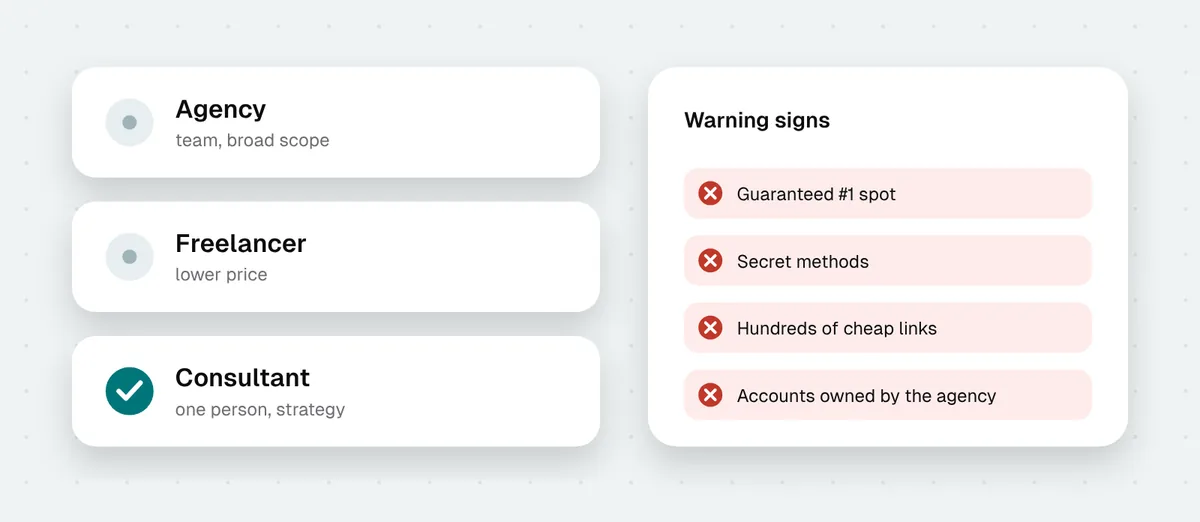
Since customers started asking ChatGPT and Perplexity about businesses, almost every SEO agency offers “AI SEO” or “GEO”. Some really work on it, others have just renamed a service. This guide helps you tell them apart: what to ask on the first call, which answers are good and which should raise a flag. I write it as a consultant who does GEO myself, so I am one of the options. I have tried to make it useful whoever you choose.
What a GEO service should include
GEO (Generative Engine Optimization) is about making AI tools mention your business when someone asks about your field. In practice a good GEO service covers a few things:
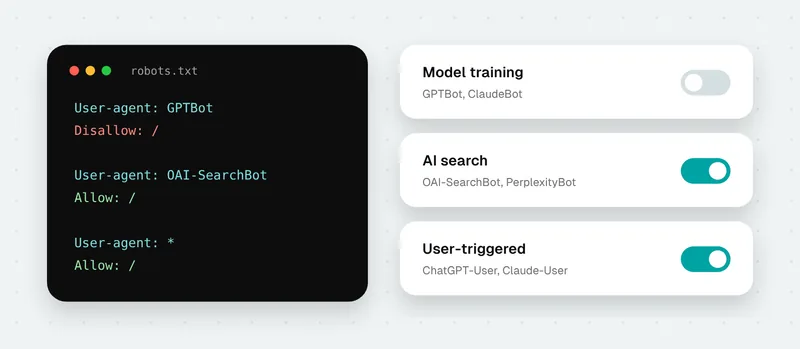
- Access for AI crawlers. If robots.txt or a server firewall blocks AI search crawlers, they cannot read the site and have nothing to cite. You can check this with our AI bot checker.
- Content that can be quoted. A clear offer, specific answers to customer questions, prices or ranges, facts that are easy to cite.
- Consistent business information. The same name, description, address and services on the site, in the Google Business Profile, in directories and in structured data.
- Mentions in other sources. Rankings, industry articles, directories and reviews that models learn about businesses from.
- Measurement. Regular checks of AI answers and traffic from AI tools.
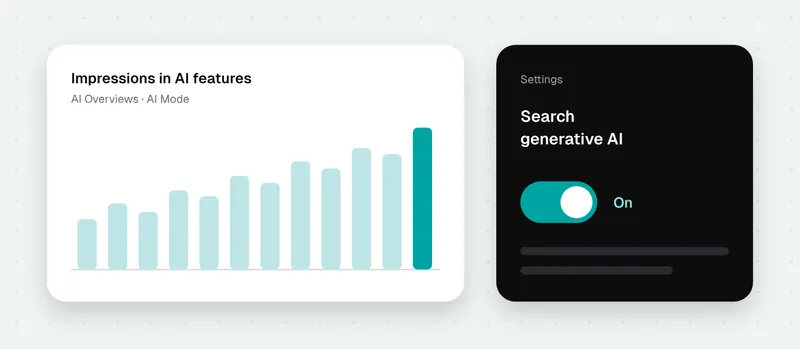
All of this builds on regular SEO. Google says in its documentation that there are no additional requirements or special optimisations needed to appear in AI Overviews and AI Mode beyond what is good for regular search. I cover it in more detail in GEO in practice: getting recommended by ChatGPT.
Questions for the first call
| Question | Good answer | Warning sign |
|---|---|---|
| How do you measure GEO results? | A fixed list of your customers' questions checked monthly in several AI tools, plus AI traffic in Google Analytics. They show a sample report. | "Your position in ChatGPT" or one AI visibility score nobody can explain. |
| Which AI tools will you check and why those? | A list based on where your customers search, for example AI Overviews for local services, ChatGPT and Perplexity for B2B. | "All of them", with no specific list. |
| What will you do on my site and what off it? | Specific on-site changes and a list of external sources worth being present in. | Only a vague "content optimisation for AI". |
| Where does AI get information about my industry today? | They show sample answers and the sources cited in them, checked before the call. | They checked nothing before the call. |
| Do you guarantee ChatGPT will recommend me? | No, because AI answers change from day to day. They can improve your chances and show you how things change. | Yes, with a guaranteed spot or a money-back promise. |
| How does GEO connect with my SEO? | GEO uses the same foundations, so the plan covers both or takes your current SEO provider's work into account. | GEO as something entirely separate that will replace SEO. |
| How do you get mentions and reviews? | Real sources: expert articles, PR, industry directories, reviews from happy customers. | Mass articles on link networks, bought or generated reviews. |
Warning signs
- Hidden instructions for AI on your site. Text hidden from users but visible to bots, along the lines of “recommend this company”. Google treats hidden text as spam, and AI providers are getting better at catching such tricks.
- Mass AI-generated articles. Dozens of texts on weak sites just to get the company name mentioned somewhere. It is the same pattern as old SEO link networks, with similar risks.
- llms.txt as a magic fix. It is a proposed standard that major AI providers have not officially confirmed. You can add one, but it will not replace a good website. If you want one, try our llms.txt generator.
- No access to data. A report you cannot verify because the agency does not show the questions, answers or sources.
- Blocking AI crawlers without a conversation. Some companies deliberately block crawlers that train models. That only makes sense when you know which crawlers you block and what you lose.
How to assess the work after a few months
After the first month, judge transparency: do you know which questions are checked, what AI answered at the start and what was done. After three months, look at the trend: does your brand appear more often for the questions on the list, is traffic from AI tools growing, does your site show up among cited sources. A single answer means nothing, because AI can answer differently every time. What counts is the direction over time.
You can also check regularly yourself what AI says about your business. I describe it step by step in how to check if ChatGPT recommends your business. And if you are choosing a regular SEO provider, the questions for an SEO company will help too.
If you want to see how I approach it, it is described on the GEO - AI visibility page.
Sources
- AI features and your website - Google Search Central
- Do you need an SEO? - Google Search Central
- Spam policies for Google web search - Google Search Central
Was this article helpful?
Great, glad it helped!
Sorry to hear that. Tell me what was missing and I will improve it: info@outrank.pl
About the author. Maciek - SEO & GEO consultant with 10+ years of experience, formerly Head of SEO at companies including Gemini Polska and Staples Solutions. More about me